
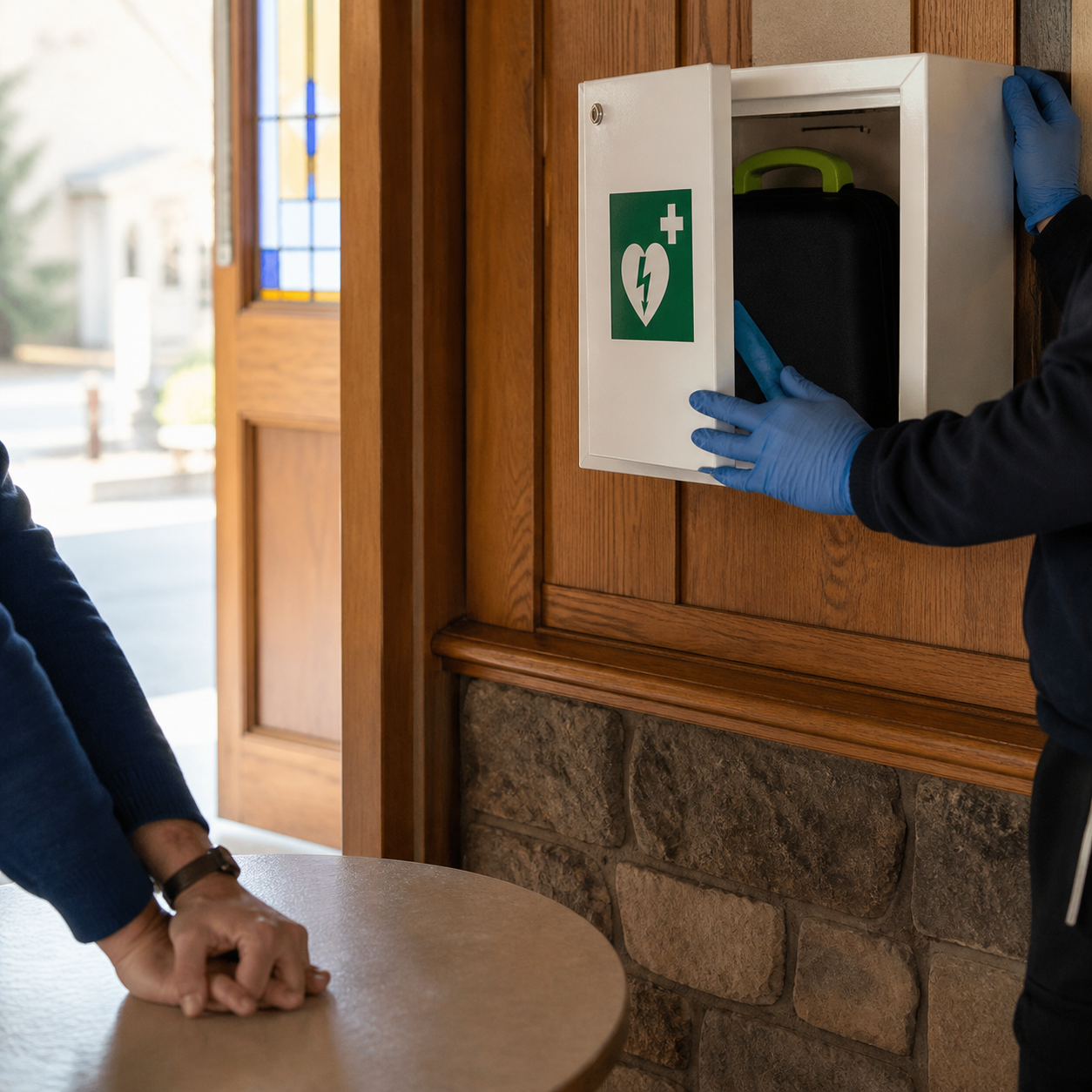
From the WTF Watch Desk: After suffering a 2007 heart attack at Sacred Heart Church in Owasco, Dr. Michael Tamul and a colleague helped fund an AED for the church. On August 15, Tamul suffered cardiac arrest at the same church.
An emergency nurse recognized the arrest, parishioners rotated through CPR and the AED delivered two shocks before his pulse returned. Tamul subsequently underwent cardiac treatment and returned home.
The remarkable symmetry should not obscure the practical reason the save was possible: a working device was reachable and people were willing to use it immediately.
Why this deserves the fire service’s attention
AED placement is only the beginning. The cabinet must be visible and unlocked, batteries and pads must be current, and people must be confident enough to recognize arrest, call for help, begin compressions and follow the prompts.
Fire and EMS agencies can turn the story into community-risk-reduction work by checking high-occupancy AED locations and helping organizations practice the first five minutes before professional responders arrive.
What Worked?
Rapid recognition, CPR, teamwork, AED access and repeated defibrillation completed the early chain of survival.
What Didn’t Work?
No emergency-response failure has been established.
What Was Missed?
Exact time intervals and the device’s inspection history were not reported.
Work • Train • Finish
Verify that public AEDs are visible, accessible, functional and assigned to someone for recurring inspection.
Run a five-minute bystander rotation: recognition, 911 access, compressions, AED retrieval, pad placement and handoff.
Celebrate a save by maintaining the system that made it possible—equipment checks, refresher practice and support for the people who performed CPR.
The outcome is extraordinary; the actions are teachable. Accessibility, readiness and immediate action turn a wall-mounted device into a survival system.